Questions to Ask Before Switching MMPs | MMP Migration Guide Questions to Ask Before Switching MMPs | MMP Migration Guide

Questions to Ask Before Switching MMPs

Nobody switches Mobile Measurement Partners on a whim. It’s one of those decisions that looks simple from the outside: “just move the data over”, and turns out to touch almost everything: media buying, budget calls, fraud checks, whatever numbers you’re presenting to leadership on Monday. Rip out the wrong piece, and you’re not just changing vendors, you’re re-earning trust in your own reporting for a month or two.

Still, teams do switch all the time. Pricing crept up past what made sense. Support stopped answering. Or the platform just never fit how affiliate and partner traffic actually behaves, and everyone’s been working around it for a year. If any of that sounds familiar, the answer isn’t to jump on the next demo call and sign whatever looks shiniest. It’s to sit down and get honest about what you’re actually solving for.

Here’s what that conversation should cover.

Why are we really leaving?

Get specific before you take a single sales call. “It’s too expensive” and “it doesn’t handle our partner mix” point you toward completely different vendors, so don’t let them blur together. A few things worth untangling:

  • Is it really the pricing, or the fact that pricing scales badly as you grow?
  • Is fraud slipping through in ways you can name, or does it just feel unreliable?
  • Does the platform genuinely struggle with affiliate and influencer traffic, or does your team just find the dashboard clunky?
  • Is support actually slow, or has one bad incident colored how the whole relationship feels?

Write the real reason down somewhere before the demos start. It’s easy for a slick sales deck to convince you that some unrelated feature is the thing you were missing all along.

What happens to our historical data?

This is the one people regret not asking about. Attribution history is genuinely hard to replace because you can’t go back and re-run last year’s campaigns through a new system. So before anything else, find out whether data can be exported in a format you’d actually use (not just summary PDFs), whether you can run the old and new systems in parallel for a while, and how long the outgoing vendor keeps your data available in case you need it for a dispute six months down the line.

If a vendor gets vague or evasive on this one question, take that as a preview of how they’ll handle every other operational question you throw at them later.

Can it actually handle the partners we work with?

Here’s something that trips people up: not every MMP is built for the same kind of traffic. A platform tuned for paid UA and app-install campaigns often does a mediocre job with a network of affiliates, sub-affiliates, and incentivized traffic, and vice versa.

So push on the specifics. Does it support postback and server-to-server tracking the way your affiliate partners already expect? Can it handle multi-tier commission structures and partner payouts natively, or is that duct-taped on through a workaround? What happens with deep linking across the actual mix you run: affiliates, influencers, ASO, paid social, not just the channel the sales rep leads with?

This is often the moment teams realize the problem was never really “MMP vs. MMP.” It’s that a generic measurement platform and something purpose-built for partner management, Affise, for instance, are answering two different questions.

How does fraud detection actually work, not just what’s on the slide?

Every vendor’s pitch deck lists the same checklist: device fingerprinting, click spam filtering, anomaly detection. Fine. What actually matters is how it works underneath.

Is fraud filtered before it hits your attribution numbers, or flagged after the fact once the damage is already in the reports? Can rules be set per partner, or is it one blunt global setting for everyone? When something’s disputed, does it get reversed automatically or does someone have to manually review it? And what’s the false positive rate? How often does it block traffic that was actually legitimate?

Ask to see a live fraud dashboard with real data, even anonymized. A slide is not a demo.

What does the actual migration timeline look like?

“Migration” sounds like flipping a switch. In practice, it means SDK updates rolling out across every app version still live in users’ hands, every partner’s tracking links getting re-verified, and a stretch of time where two systems run side by side, and you’re reconciling numbers between them.

Get real answers: how long does a migration at your size typically take, start to finish? Will you need an app store release to update the SDK, and how many release cycles does that eat up? Do partners need to update their own tracking links or postbacks, and who’s coordinating that with them? What does the parallel-run period actually look like, and who owns reconciling the discrepancies that will inevitably show up?

Is the pricing predictable, or just reasonable today?

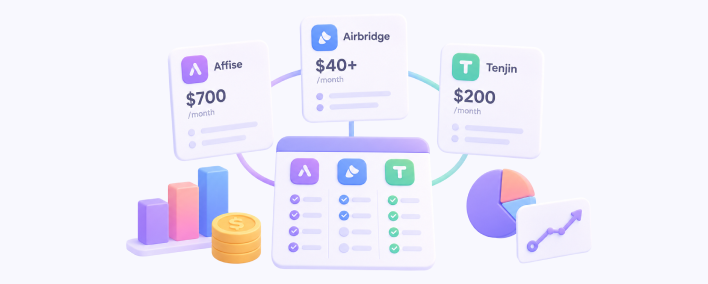
Pricing that looks fine at your current volume can quietly become next year’s problem. Worth asking: is it based on installs, sessions, MAUs, or something else entirely, and what happens to the bill as that number climbs? Are fraud-filtered installs still billed, or excluded? What’s bundled in versus charged as an add-on: deep linking, cohort analysis, extra partner integrations, API access? And can they show you a real contract from a company at roughly your scale, not just a pricing page?

What happens when something actually breaks?

Attribution problems have a habit of surfacing at the worst possible moment: mid-campaign, mid-launch, right before month-end reporting. Before you sign anything, find out if there’s a dedicated account manager or just a shared support inbox. Get actual response times in writing, not “as soon as possible.” Ask if there’s a public status page or incident history you can look at. And honestly, just talk to an existing customer, ideally one who’s already been through onboarding and a full campaign cycle, not someone still in their honeymoon period.

Does it actually fit into the rest of your stack?

No MMP or partner platform operates alone. Check the integrations with your ad networks and paid social platforms, your BI or data warehouse setup, your product analytics, and whatever you’re already using to manage partners and payouts if you’re not consolidating everything into one system. If hooking it up means building and maintaining custom middleware yourselves, that’s a real cost; factor it into what the switch actually costs, not just the subscription price.

Who owns this internally, and what’s the fallback if it goes sideways?

Migrations tend to fail from a lack of clear ownership more often than from actual vendor problems. So before you start: who owns this end-to-end, marketing ops, growth, data, engineering? What’s the go/no-go checklist before you fully cut over? And if something breaks mid-migration badly, what’s the actual plan to roll back without losing data in the process?

The question underneath all the other questions

A lot of teams start this process assuming they need a new MMP, and end up realizing the real gap was never attribution accuracy, it was managing the partners themselves. A traditional MMP tells you where an install came from. A partner marketing platform like Affise is built for the relationship on the other side of that number: tracking, deep linking, fraud protection, and payouts across affiliates, influencers, and networks, often running alongside an MMP rather than replacing it.

So before you sign the next MMP contract, it’s worth sitting with one more question: is this actually about measurement, or is it about partner management that no MMP, old or new, was ever really built to handle?

Frequently Asked Questions

1. What technical factors should mobile app growth teams review before migrating to a new MMP?

When evaluating a platform switch, teams must examine SDK integration effort, tracking link migration, and how seamlessly the new partner ingests existing historical data. It is crucial to verify that the provider supports modern privacy standards like Apple’s SKAdNetwork and offers granular event-tracking capabilities out of the box. Additionally, app marketers should confirm how real-time postbacks and automated partner callbacks are handled during the transition period. To better understand how these attribution mechanics work under the hood, you can review this in-depth guide on mobile attribution tracking. Ensuring technical compatibility beforehand prevents tracking downtime and maintains reporting integrity across all active user acquisition campaigns.

2. How does switching MMPs impact cross-channel attribution and ad spend evaluation?

Changing mobile measurement providers requires auditing how user touchpoints—such as ad clicks, impressions, and post-install events—are assigned credit across various paid ad networks. A robust attribution provider should eliminate duplicate conversion claims and provide clear cross-channel visibility across your entire marketing stack. Evaluating pricing models and data access before making the move ensures you do not face unexpected cost spikes when scaling paid campaigns. Marketers seeking a foundational breakdown of these concepts can read through the comprehensive guide to mobile attribution. Ultimately, establishing unified reporting metrics helps marketing leaders optimize ad spend and accurately determine campaign ROI.

3. How can businesses maintain campaign continuity when expanding web and mobile conversion paths during an MMP switch?

Transitioning to a new measurement platform involves mapping out web landing pages, deferred deep links, and mobile app install touchpoints without fragmenting user journeys. Before completing a migration, growth managers must confirm how well the new MMP connects web traffic to post-install in-app conversions. Running both platforms in parallel during initial testing allows teams to compare data accuracy without risking loss of user attribution data. For practical advice on connecting online touchpoints to app conversions, check out this guide on web-to-app attribution strategies. Proper alignment across web and app channels guarantees that your customer acquisition funnels remain effective throughout the transition.

4. How long does switching MMPs actually take?

For most mid-sized apps with a handful of partner integrations, figure on 4-8 weeks from kickoff to full cutover, including a parallel-run period to reconcile the numbers. Bigger portfolios, multiple apps, markets, or a heavier partner load can take a good deal longer, especially if you need fresh app store releases to update the SDK.

5. Will we lose our historical attribution data?

Not necessarily, but don’t take that on faith. Confirm export formats and retention windows with both the outgoing and incoming vendor, and pull a full historical export yourself as a safety net regardless of what either one promises.

6. Can we run two MMPs side by side during the switch?

Yes, that’s actually the normal way to do it. A parallel-run period, usually a few weeks to a full campaign cycle, lets you compare numbers between old and new before you fully cut the cord on the legacy SDK

7. Is switching MMPs the same thing as adopting a partner marketing platform?

Not quite. An MMP is about measurement and attribution. A partner marketing platform, Affise, for example , is about managing the partner relationship itself: tracking, deep linking, fraud protection, payouts, across affiliates, influencers, and networks. Some teams genuinely need to replace their MMP. Others realize what they actually need is partner management running alongside the MMP they already have.

8. What do teams underestimate most when switching?

Ownership and timeline, more than the technology itself. Discrepancies during the parallel-run period, coordinating with partners, and app store release cycles cause more delays in practice than any single missing feature ever does.


Share this article
Aru

Written by

See all articles →

Sign up to receive our newsletter

Stay on top of the competition. Let us keep you updated with news, insights, and more

email envelope